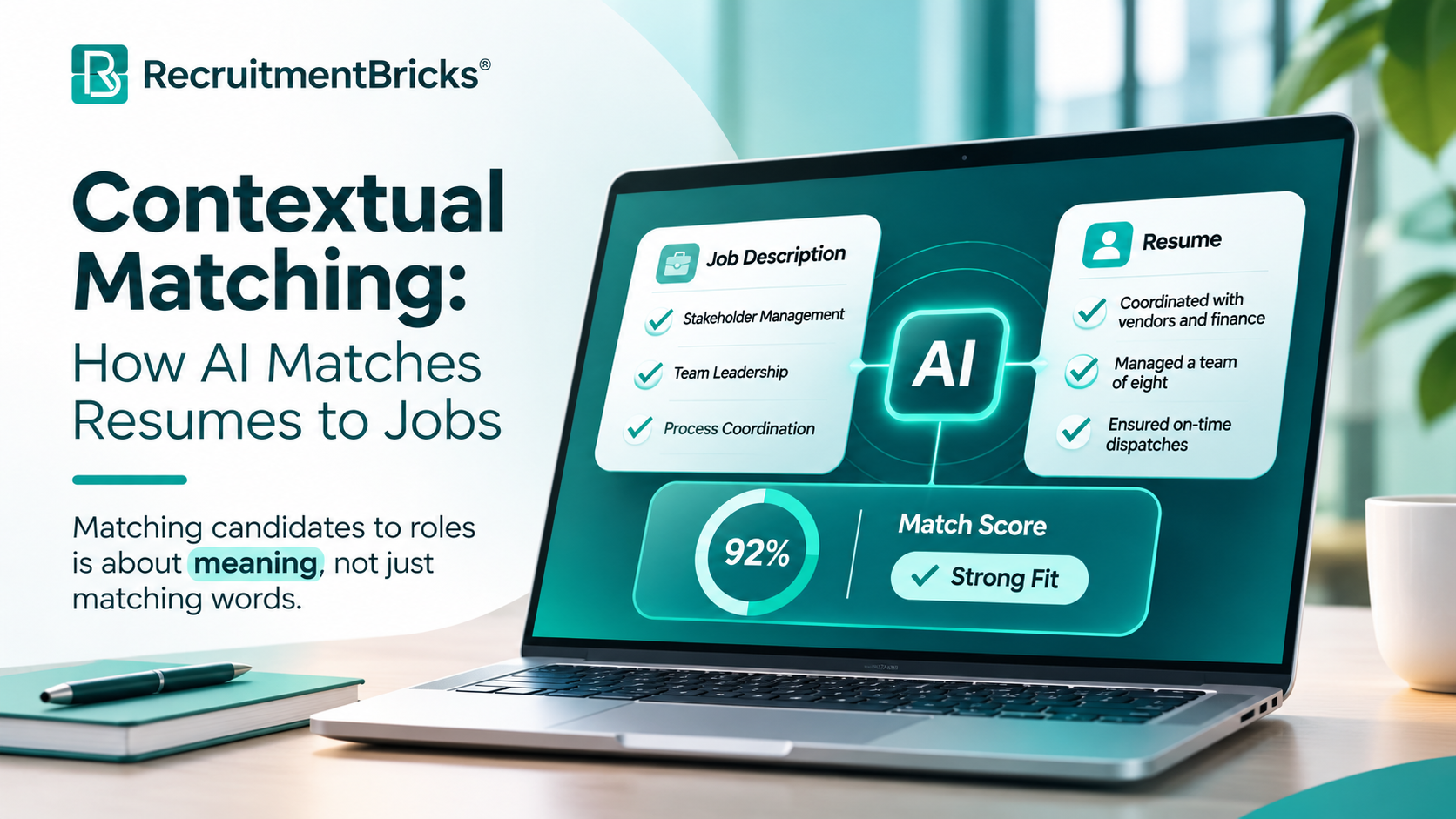
Matching candidates to roles is about meaning, not just matching words.
A job description asks for “stakeholder management.” A resume says, “coordinated with vendors, warehouse heads, and finance teams to keep dispatches on schedule.” The skill is the same, but the words are different. A recruiter would connect the two instantly. A simple keyword search would not. This is the gap that contextual matching closes.
What Is Contextual Matching?
Contextual matching uses AI to understand the meaning of a job description and a resume, not just the words on the page. It looks at the skills, the experience, and the way both are described, then compares the role and the candidate on what they actually say.
Why Keyword Matching Falls Short
Matching exact words can miss good candidates and mislead recruiters:
- Different words, same skill: “Team lead” and “managed a team of eight” mean the same thing, but they don’t look alike.
- Same word, different meaning: “Pipeline” means one thing in sales and another in engineering.
- Context gets lost: A skill listed once in a summary is not the same as a skill used daily for three years.
How a Contextual Match Works
- Understand the role: The AI reads the job description and identifies the required skills, experience level, and responsibilities.
- Understand the candidate: It reads the resume the same way, capturing skills, work history, and qualifications.
- Compare meaning: It checks how closely the candidate’s experience lines up with what the role needs, even when the wording differs.
- Produce a match score: The result is a score showing how well the profile fits the role.
- Review: The recruiter checks the findings and decides who moves forward.
The AI does the comparison. Recruiters make the decision.
Why Explainable Matching Matters
A match score is only useful if you can trust it. A number with no reasoning forces recruiters to either accept it blindly or ignore it.
Explainable matching shows why a candidate fits: which skills and experience line up with the job description, and where the gaps are. Recruiters can judge for themselves whether the match holds up, and every shortlist comes with a clear rationale for hiring managers.
It also supports the principles of responsible AI in recruitment: transparency, fairness, and appropriate human oversight.
Benefits of Contextual Matching
- Fewer missed candidates: People are recognized for what they’ve done, not just the phrases they used.
- More relevant shortlists: Matches reflect real experience, not word overlap.
- Clearer conversations: Reasoning behind each score gives hiring teams something concrete to discuss.
- Less guesswork: Recruiters spend less time interpreting differently worded resumes.
What to Look For in a Matching Tool
- Does it understand meaning, or only exact words?
- Does it explain its match scores?
- Can recruiters review and correct what it reads?
The best tool makes matching more accurate without making decisions harder to understand.
Match on Meaning, Decide with Judgement
Contextual matching doesn’t take people out of hiring. It gives recruiters a clearer, better-reasoned starting point, so their time goes to understanding candidates.
Want to see it in action?
Explore Recruitment Bricks AI to see how contextual matching and explainable scoring can support your hiring workflow.
Book a demo →
Frequently Asked Questions
1. What is contextual matching between a JD and a resume?
It is an AI-based comparison that looks at the meaning of a job description and a resume, rather than only matching exact words.
2. How is it different from keyword matching?
Keyword matching looks for the same words in both documents. Contextual matching recognizes when different words describe the same skill or experience.
3. What is a match score?
A match score shows how closely a candidate’s resume lines up with a job description. With explainable matching, the reasons behind the score are shown too.
4. Why does explainability matter?
It lets recruiters see why a candidate was matched, so they can verify the result and explain their shortlist to hiring managers.
5. Does contextual matching replace recruiters?
No. It handles the comparison, while recruiters review the results, speak with candidates, and make the hiring decisions.